
 Dansk
Dansk Norsk
Norsk Svenska
 Deutsch
Control of drinking water
Drinking water consists of many components, and not all are ones we think about when using the water in production, privately, or in, for example, canteens and industrial kitchens. We have highlighted some of the essential factors and limits below:
Color Level
A high color value indicates that the water is not clear but has a yellowish hue. This is typically due to a high content of organic material, such as humus, which can also be identified later in the analysis through a high NVOC value.
Limits for Color Level:
- At waterworks exit: Maximum 5 mg Pt/l, however, up to 10 mg Pt/l is accepted for humus coloring.
- In the distribution network: Maximum 15 mg Pt/l.
Turbidity
Turbidity, or cloudiness, is measured in FTU (Formazin Turbidity Units) and indicates the murkiness of the water. Although high turbidity can indicate the presence of fine particles not immediately visible to the naked eye, an increased content of iron or manganese can also be reflected as elevated turbidity.
Limits for Turbidity:
- At waterworks exit: Maximum 0.3 FTU.
- In the distribution network: Maximum 1 FTU.
Odor and Taste
Drinking water should taste good and have no odor, and therefore should smell relatively neutral. This is subjectively assessed in the water analysis.
Electrical Conductivity
Electrical conductivity, also known as conductivity, is used to assess the water's content of dissolved salts and serves as a quick method for salt content control.
Limits for Electrical Conductivity:
- At waterworks exit and in the distribution network: Minimum 30 mS/m.
Magnesium Content
Magnesium, along with calcium, contributes to the water's hardness. Too high magnesium content can affect the taste and act as a mild laxative.
Limits for Magnesium:
- At waterworks exit and in the distribution network: Maximum 50 mg Mg/l.
Total Hardness
Calcium and magnesium determine the total hardness of the water, where high levels result in hard water and low levels in soft water. The hardness is expressed in German hardness degrees (°dH).
Water Hardness Classification:
- 0°-4° dH: Very soft
- 4°-8° dH: Soft
- 8°-12° dH: Medium hard
- 12°-18° dH: Fairly hard
- 18°-30° dH: Hard
- Over 30° dH: Very hard
Iron Content
Iron is an element primarily desired to be removed in water treatment due to the problems it causes, such as deposits, laundry issues, and bad taste. Although high iron levels are rarely harmful, under certain conditions, they can promote the growth of iron bacteria.
Limits for Iron:
- At waterworks exit: Maximum 0.1 mg Fe/l.
- In the distribution network: Maximum 0.2 mg Fe/l.
Manganese Content
Manganese, often found together with iron, causes similar problems but to a lesser extent. Treated water should be completely free of manganese.
Limits for Manganese:
- At waterworks exit: Maximum 0.02 mg Mn/l.
- In the distribution network: Maximum 0.05 mg Mn/l.
Microbiological Parameters:
Coliform bacteria are considered indicators of contamination, as they thrive in environments together with pathogenic bacteria. Their presence indicates the need for further analysis.
Escherichia coli (E. coli) in drinking water indicates fresh contamination and a risk of pathogenic bacteria.
Colony counts at 37° C and 22° C measure pathogenic and non-pathogenic bacteria, respectively, with specific limits for waterworks exit and the distribution network.
-
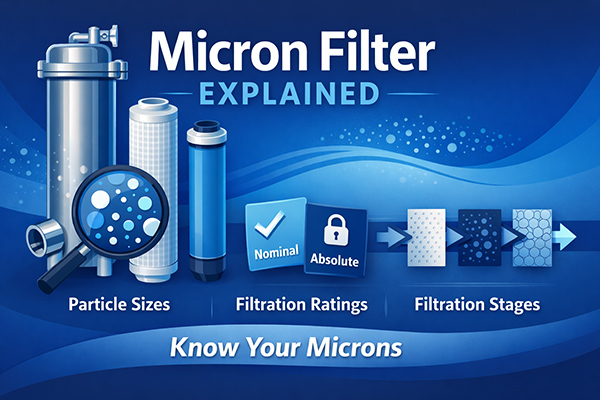
Micron filter explained
 March 5, 2026
 -
Nordic Filtration acquires Scandi-Tech
 December 1, 2025
 -
Replacement elements for Compressed Air
 October 27, 2025
 -
Guide to choosing the correct compressed air filter - BCAS
 September 4, 2025
 -
First year in Nordic Filtration - CEO reports
 June 22, 2025